

General Dentistry
Oral Cancer Screening in Washington, DC
A quick, painless check of the soft tissues of your mouth for early signs of oral cancer — included as part of your regular dental visit, with nothing to prepare for.

Google Rating
4.9 · 303 reviews
Availability
Same-day consults
Payments
Financing available
The Basics
What Happens During an Oral Cancer Screening?
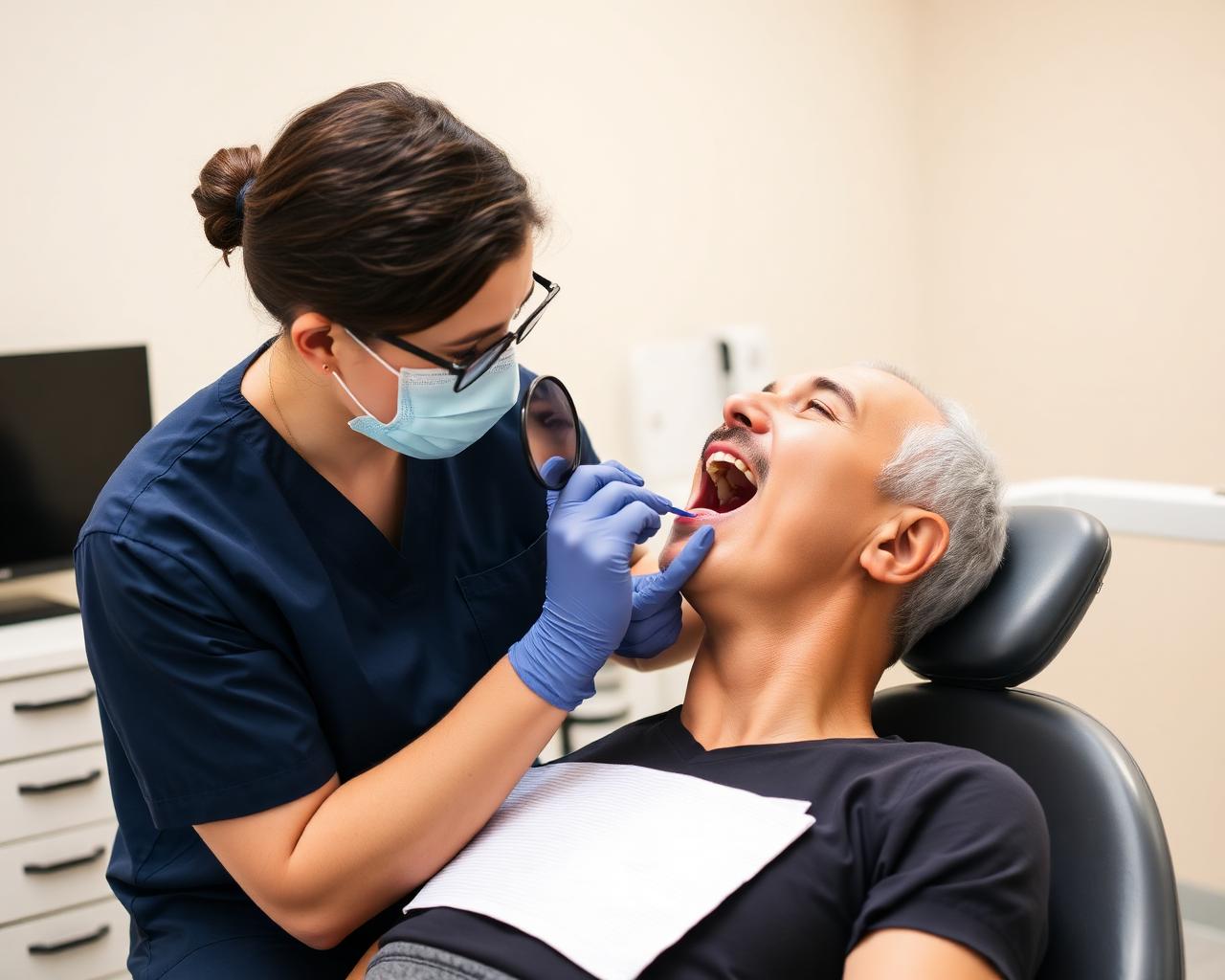
An oral cancer screening is a short visual and physical examination of the lips, cheeks, tongue, gums, roof and floor of the mouth, and throat, looking for unusual sores, lumps, discoloration, or changes in texture. It is non-invasive, takes only a few minutes, and is carried out as part of your regular dental exam.
What we look at
- The lips, inside and out, and the corners of the mouth
- The inside of both cheeks and the tissue where cheek meets gum
- The top, sides, and underside of the tongue
- The floor of the mouth beneath the tongue and the roof of the mouth
- The gums, the back of the throat, and the tonsil area
- The jaw, under the chin, and the sides of the neck by gentle touch
Nothing you need to do beforehand
There is no preparation, no dietary restriction, and no recovery. The screening happens alongside the rest of your exam and X-rays and adds only a few minutes to the appointment. The one thing that genuinely helps is telling us about anything you have noticed yourself, however minor it seems.
At a glance
Oral Cancer Screening
- Time added to a visit
- Typically just a few minutes
- Recommended frequency
- As part of each regular check-up
- Discomfort
- None — the screening is non-invasive
- Who should be screened
- Adults generally, at every recall visit
- Preparation
- None required
- Billed separately
- No — part of the routine exam
Tobacco or heavy alcohol use makes regular screening more important, not less — tell us and we will advise on the right interval for you.
Book Appointmentor call (202) 363-2810
Prevention
Why Regular Screening Matters
Oral cancer can begin without pain, and painless changes are easy to live alongside without noticing. Regular screening is simply a way of making sure someone is looking.
Early stages are often silent
In its early stages, oral cancer frequently causes no pain and little in the way of obvious symptoms — an area of the mouth simply looks or feels slightly different. That is why the screening is done at routine visits for patients with no complaints at all, rather than only when something hurts. Catching a change early generally leads to better outcomes than finding it late.
Consistency is what makes it work
Being examined by the same practice at regular intervals means a new patch or a change in an existing one stands out. Regular screening as part of routine exams and cleanings is one of the best tools available for early detection.
Known risk factors
- Tobacco use in any form — cigarettes, cigars, pipes, chewing tobacco, or vaping products
- Heavy alcohol use, particularly in combination with tobacco
- Infection with certain strains of HPV
- Significant sun exposure, which is a factor specifically for cancers of the lip
- Age, with risk generally increasing over time
Having a risk factor does not mean you will develop oral cancer, and many people diagnosed have none of them. If you use tobacco, our tobacco and your oral health page covers what it does to the mouth. The National Institute of Dental and Craniofacial Research and the American Dental Association’s MouthHealthy oral cancer overview are both reliable independent sources.
Awareness
Signs Worth Getting Checked
These are reasons to get checked — not a self-diagnosis list. Every one of them has common, harmless explanations that are far more likely than cancer.
Worth mentioning to your dentist
- 1A sore or ulcer in the mouth that has not healed within about two weeks
- 2An unexplained red or white patch on the gums, tongue, or lining of the mouth
- 3A lump or thickening in the mouth, lip, cheek, or neck
- 4Persistent numbness or an odd sensation in the mouth, lip, or tongue
- 5New difficulty swallowing, chewing, or moving the jaw or tongue
- 6A sore throat or the feeling of something caught that does not clear up
Most of these turn out to be something ordinary
Canker sores, a cheek bitten while eating, irritation from a sharp filling or a denture edge, a burn from hot food, and ordinary infections account for the overwhelming majority of the changes patients bring to us. Finding out takes a few minutes.
The useful rule is the two-week one: anything in the mouth that has not settled on its own after roughly two weeks deserves a look, whatever it turns out to be.
Book AppointmentThe Process
The Screening Process
Three short stages, folded into the routine exam rather than booked as a separate visit.
Visual Exam (Lips, Cheeks, Gums, Tongue)
A minute or two
We look carefully at the lips, the inside of the cheeks, the gums, the top and underside of the tongue, and the roof and floor of the mouth for sores, unusual red or white patches, or changes in color and texture.
Physical Exam (Feeling for Lumps or Texture Changes)
About a minute
Using gloved hands, we gently feel the tissues of the mouth, the floor of the mouth under the tongue, and the jaw and neck for lumps, thickenings, or firm areas that would not be visible on their own.
Discussion of Findings
Same visit
We tell you what we saw, whether anything is worth keeping an eye on, and what the next step is if it is. In the great majority of visits, the answer is simply that everything looked normal.
Next Steps
What Happens If Something Is Found?
Being told we want a closer look at something is not the same as being told it is serious. Here is how it actually goes.
Most findings are benign
The great majority of unusual areas we see have straightforward explanations — an ulcer, trauma from biting, irritation from a rough filling or a denture edge, or a harmless normal variation. Where the cause is obvious and fixable, we deal with it and the area settles.
Watch and re-check
For something that looks likely to be irritation, the usual step is to remove the cause and re-examine the area after a short interval. An area that heals as expected needs nothing further; an area that does not is followed up rather than forgotten.
Referral and biopsy
If an area is persistent or has features that warrant a definitive answer, you are referred for further evaluation and, where indicated, a biopsy — because only a biopsy can confirm what tissue actually is. We explain what we are seeing and why, and help arrange the appointment rather than leaving you to chase it.
You will hear it straight
We do not leave patients guessing at what a pause or a note in the chart meant. If there is something to discuss, Dr. Kambez Shukoor discusses it with you at the visit, in plain language, along with what the realistic possibilities are.
Investment
What Does an Oral Cancer Screening Cost in Washington, DC?
In this practice the screening is part of your routine examination rather than a separately billed service, so for most patients there is no additional cost at all.
Included in your exam
- The visual and physical screening is performed as part of the routine exam
- It is not billed as a separate line item
- No preparation, no extra appointment, no added chair time to speak of
Insurance coverage
- Preventive exams are covered at or near 100% by most PPO plans
- Because the screening is part of that exam, it is covered where the exam is
- We verify your benefits before the visit so nothing is a surprise
If further evaluation is needed
- Any additional diagnostic step is explained and costed before it is done
- Referral for biopsy is billed by the specialist practice, not by us
- You will always know the out-of-pocket figure before agreeing to anything
We do not publish flat prices. Coverage is verified before your visit and anything not covered is explained on our financial information page.
Why Choose
DC Implant & Cosmetic Dentistry
Preventive care that includes the checks patients never think to ask for, handled by Dr. Kambez Shukoor in one Connecticut Avenue office.
Screening at Every Recall Visit
The check is built into your routine exam rather than being something you have to ask for or book separately.
A Few Minutes, No Discomfort
Looking and gently feeling — no needles, no dye you have to swallow, no numbing, and nothing to recover from afterwards.
Straight Answers, No Alarm
If we see something, we tell you plainly what it is likely to be, what it is probably not, and what the sensible next step is.
Experienced Eyes
Dr. Kambez Shukoor holds FAGD, FICOI, and MICOI credentials, and examines the soft tissues of the mouth many times a day — which is what makes an unusual patch stand out.
Referral When It's Warranted
Anything that needs a specialist opinion or a biopsy is referred promptly, and we help arrange the appointment rather than handing you a phone number.
Insurance Handled For You
The screening is normally part of a covered routine exam. Benefits are verified in advance and anything not covered is explained on our financial information page.
FAQ
Oral Cancer Screening Questions
The questions Washington, DC patients ask most often about screening, risk, and what happens next.
Related
Part of a Routine Visit
The preventive appointments the screening sits inside — the exam that finds problems early and the cleaning that keeps them away.
Noticed something that hasn't healed?
Book a visit and we will take a proper look. Most of what patients bring us is harmless — and finding that out takes a few minutes.
4444 Connecticut Ave NW #106, Washington, DC 20008