
Oral & Implant Surgery
Ridge Augmentation in Washington, DC
If you were reading about dental implants and were told the ridge is too narrow, this is that step. Ridge augmentation rebuilds the width and shape of a collapsed jaw ridge so an implant has enough bone to anchor into and the final restoration sits with a natural gum contour — performed in-house by Dr. Kambez Shukoor as part of the same treatment plan.

Google Rating
4.9 · 303 reviews
Availability
Same-day consults
Payments
Financing available
Definition
What Is Ridge Augmentation?
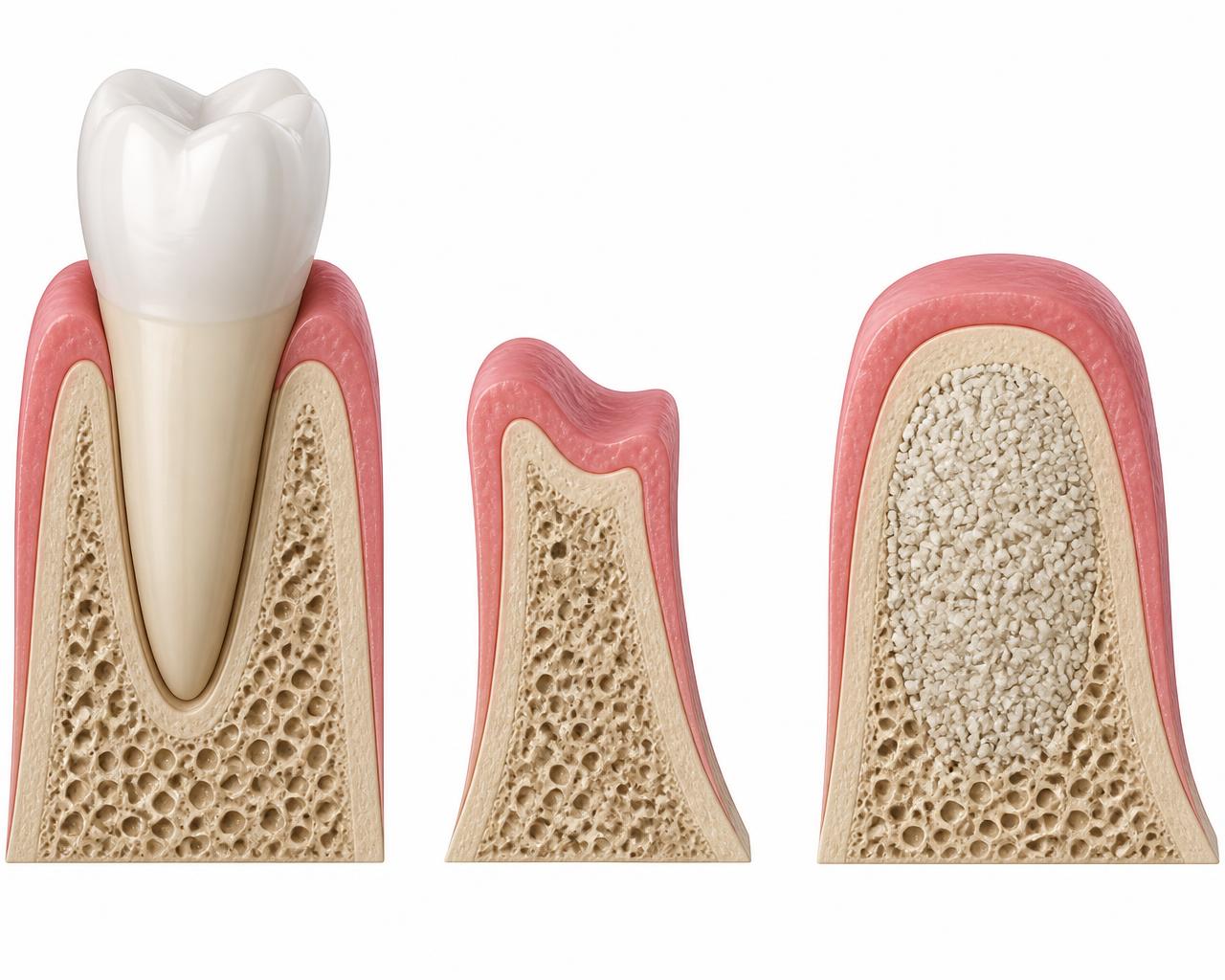
Ridge augmentation is a procedure that rebuilds the width and shape of the jaw ridge where it has collapsed after tooth loss, so a dental implant has enough bone around it on every side. It is performed in either arch, anywhere along the ridge, and it restores the gum contour the final crown sits against as well as the bone beneath it.
Three procedures get discussed at this stage and they are easy to confuse. Bone grafting is the general term for rebuilding lost jawbone at an implant site. Sinus lift is the upper-back-jaw version, adding vertical height beneath the sinus. Ridge augmentation is a type of bone grafting focused specifically on a collapsed or narrow ridge — width and contour rather than height. Once the graft matures, the implant is placed and osseointegration proceeds normally.
Why the ridge collapses
- Bone around a tooth root exists to support it — remove the root and it resorbs
- The outer wall of the ridge is the thinnest, so width is usually lost first
- Most of the change happens in the first year, then continues slowly for years
- Extractions done without socket preservation collapse more than grafted sockets
- Periodontal disease and long-term denture wear both accelerate the flattening
What augmentation restores
- Enough ridge width to fully enclose an implant of the correct diameter
- A natural ridge contour, so the crown doesn't look long or flat next to its neighbors
- Stable bone and gum architecture that holds its shape over the long term
At a glance
Ridge Augmentation
- Procedure length
- About 60–90 minutes, by extent
- Anesthesia
- Local, with sedation available
- Healing before implant
- Typically 4–6 months
- Applies to
- Upper or lower arch, any location
- Primary goal
- Width and contour restoration
or call (202) 363-2810
Extent
How Severe Is the Loss
Ridge augmentation is not one fixed procedure — it scales with how much width has been lost. The scan places your case on this spectrum, and that decides both the timeline and whether the implant can go in at the same visit.
Minor Ridge Narrowing
The ridge has thinned slightly but still holds most of its shape. A small amount of graft material is added to widen the site enough for a standard-diameter implant.
- Often placed at the same appointment as the implant
- Shortest procedure and the easiest recovery of the three
- Small volume of graft material and no separate surgical visit
- Only possible when enough native ridge remains to hold the implant
Moderate Ridge Loss
The ridge is visibly narrow on imaging and would not fully enclose an implant. The site is grafted first, then left to heal before the implant is placed.
- Reliable width gain across a defined span of the ridge
- Usually protected with a barrier membrane while it heals
- Staged — implant placement waits for the graft to mature
- Adds roughly four to six months before implant surgery
Significant Ridge Collapse
Years of tooth loss have left a thin, flattened ridge. Rebuilding takes more material and sometimes a block graft secured to the remaining bone.
- Restores enough width and contour to make implants possible again
- Improves the gum shape under the final crown, not just the bone
- The most involved of the three, with more swelling afterward
- Longest healing period before an implant can be placed
The general rule: the less native ridge is left, the more material it takes and the longer the wait before implants. If the shortfall turns out to be height rather than width, the right procedure is a sinus lift in the upper back jaw, or standard bone grafting elsewhere.
The Process
The Ridge Augmentation Process
Ridge augmentation is one stage inside a longer implant plan. The surgery is short; the months afterward are what turn the graft into a ridge an implant can hold in.
Consultation & 3D Imaging
Visit 1
A cone-beam scan measures the ridge in cross-section — how wide it is, where it has collapsed inward, and whether an implant of the right diameter would be fully enclosed in bone.
Ridge Augmentation Procedure
Surgery day
Under local anesthetic, the ridge is exposed and graft material is placed along the deficient side to rebuild width and contour, usually protected by a barrier membrane.
Initial Healing
Weeks 1–2
The gum is closed over the grafted ridge. Swelling and soreness fade over the first week or two, and a short review visit confirms the site is sealed and settling.
Bone Integration
4–6 months
This is the long step. The graft matures into stable bone that holds its new width. Larger rebuilds and block grafts sit at the longer end of that range.
Implant Placement
Once integrated
A follow-up scan confirms the ridge is wide and stable, then the implant is placed into the rebuilt site and the original implant plan continues.
Candidacy
Do You Need One
Ridge augmentation answers one specific problem: not enough width. The 3D scan settles it — but these are the patterns that point one way or the other.
Signs augmentation is likely needed
- 1The ridge looks visibly thin, sunken, or knife-edged on exam
- 2Imaging shows the ridge is too narrow for a standard-diameter implant
- 3A tooth has been missing for years and the area has flattened
- 4An extraction was done without socket preservation and the site collapsed
- 5A planned crown would look long or flat because the gum contour is lost
When a different procedure fits better
If the shortfall is vertical height under the sinus in the upper back jaw, that is a sinus lift, not a ridge augmentation. A recent extraction with intact bone walls usually needs only socket preservation, and a ridge that already measures wide enough needs nothing added at all.
These are the other two bone-building procedures. Cases with both width and height loss are sometimes planned as a combination.
Both are performed in-house by Dr. Kambez Shukoor.
Recovery
Recovery After Ridge Augmentation
Two recoveries, not one
Surface recovery is short: swelling and soreness settle over the first week or two and routine returns quickly. The recovery that actually matters is the one you cannot feel — four to six months of the graft maturing into bone that holds its new width. Feeling fine at two weeks does not mean the ridge is ready for an implant.
The first 72 hours
- Ice in 20-minute intervals on the first day; swelling peaks around day two
- Soft foods only, chewing away from the grafted side
- No smoking and no straws — suction and nicotine both threaten a graft
- Do not rinse forcefully, spit, or pull the lip out to inspect the site
- Take prescribed medication on schedule rather than waiting for pain
Weeks one to six
- Gentle warm salt-water rinses from the day after surgery
- Brush the rest of the mouth normally and keep the site clean as directed
- A short review visit confirms the gum has closed over the rebuilt ridge
- If you wear a temporary partial or flipper, it may need adjusting so it doesn't press on the graft
The integration months
- The graft matures into stable, load-bearing bone over roughly four to six months
- Significant rebuilds and block grafts take the longer end of that range
- A follow-up scan confirms the ridge width before implant surgery is booked
- Routine cleanings continue through this period to protect the surrounding tissue
Anxious patients can have the procedure done with sedation available alongside local anesthetic.
| Timeframe | What to expect |
|---|---|
| Day 1–3 | Swelling and soreness peak; ice, soft foods, prescribed medication |
| Week 1 | Discomfort fades; most people are back to routine activity |
| Week 2 | Soft tissue closed over the ridge; review visit confirms healing |
| Weeks 3–6 | Normal diet resumes gradually — but the graft is still immature |
| Months 4–6 | Bone integration; the ridge stabilises at its new width |
| Implant placement | Follow-up scan confirms width, then the implant is placed |
Investment
What Does Ridge Augmentation Cost in Washington, DC?
We do not publish a single price, because a minor widening and a full ridge rebuild are not the same procedure. Here is what moves the number.
Extent of the ridge loss
- Minor narrowing takes the least material and the least chair time
- A long collapsed span costs more than a single narrow site
- Significant collapse may need a block graft, which is quoted separately
Material & technique
- Particulate graft material sits below block grafting on cost
- Barrier membranes and fixation are itemized as their own lines
- Technique is chosen by what the ridge needs, not by budget alone
Combined or separate visit
- A minor augmentation done with the implant shares one surgical visit
- A staged augmentation carries its own surgical and anesthesia fee
- Sequencing is planned to keep total visits down where it's safe to do so
Ridge augmentation is quoted as part of the whole implant plan, not as an isolated surprise — surgery, graft material, and the implant work that follows are itemized in writing before anything begins. We verify your insurance benefits and explain monthly payment options on our financial information page, including CareCredit and Cherry financing.
Why Choose
DC Implant & Cosmetic Dentistry
Dr. Kambez Shukoor is a U.S. Navy veteran dentist with fellowship-level implant training who handles the surgery and the final prosthesis himself.
Surgery & Crown in One Office
Dr. Shukoor places the implant and restores it himself, so there's no hand-off between a surgeon and a separate restorative dentist.
Implant-Focused Credentials
FAGD, FICOI, and MICOI credentials backed by continuing education specific to implant surgery and prosthetics.
Guided 3D Planning
Cone-beam imaging and digital scanning position every implant before the day of surgery, not during.
Comfort-First Care
Local anesthetic, sedation options, and a slow, explained pace for patients who are anxious about oral surgery.
Honest Case Planning
If the ridge is already wide enough — or a narrower implant option avoids grafting — that's what gets recommended.
Transparent Costs
Written treatment plans with itemized fees, insurance coordination, and third-party financing through CareCredit and Cherry.
FAQ
Ridge Augmentation Questions
The questions Washington, DC patients ask most often before rebuilding a collapsed jaw ridge for dental implants.
Related
Where This Leads
Ridge augmentation prepares the site for an implant. These are the procedures it leads to, and the two related bone-building options.
Single Tooth Implants
One implant and one crown — the most common destination after a ridge is rebuilt.
Single Tooth ImplantsMultiple Teeth Implants
Individual implants or an implant bridge where several teeth are missing in a row.
Multiple Teeth ImplantsFull-Arch Implant Solutions
A fixed full arch on four implants once the ridge can support them.
Full-Arch Implant Solutions