

General Dentistry
Dental Fillings in Washington, DC
Tooth-colored fillings that treat cavities and rebuild a tooth's shape, strength, and biting surface — placed, shaped, and polished in a single visit on Connecticut Avenue.

Google Rating
4.9 · 303 reviews
Availability
Same-day consults
Payments
Financing available
The Basics
What Is a Dental Filling?
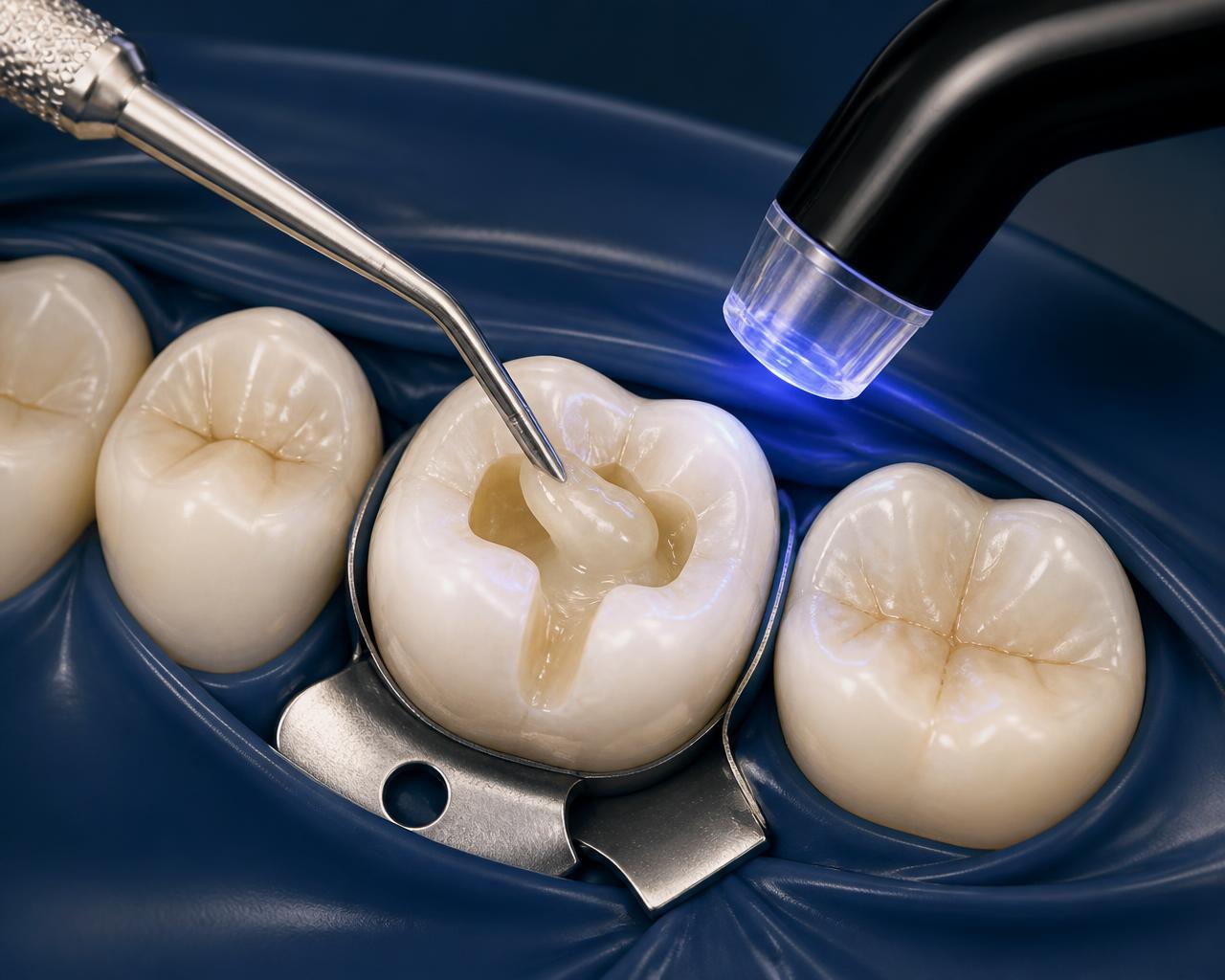
A dental filling treats a cavity by removing the decayed tooth material and filling the space left behind, restoring the tooth’s shape, strength, and biting surface. Modern fillings are typically tooth-colored composite resin bonded directly to the tooth, rather than the silver amalgam many patients remember from childhood.
What a filling actually does
- Removes decay before it can spread deeper toward the nerve
- Rebuilds the missing tooth structure so you can chew normally again
- Seals the margin, keeping bacteria out of the cleaned area
- Restores the contact point with the neighbouring tooth so food stops packing in
- Ends the sensitivity that exposed dentin was causing
Why decay does not heal on its own
Very early enamel demineralisation can sometimes be arrested with fluoride and better home care. Once bacteria have broken through into the softer dentin underneath, though, the cavity only gets bigger — the tooth cannot regenerate that structure. The American Dental Association’s MouthHealthy overview of tooth decay is a useful independent explanation of how that process works.
Caught early, the repair stays small
The difference between a twenty-minute filling and root canal treatment is usually just time. That is the entire argument for keeping up with exams and X-rays, which find decay between teeth while it is still shallow.
At a glance
Dental Fillings
- Treatment time
- About 20–60 minutes, depending on size
- Number of visits
- Typically one
- Anesthesia
- Local anesthetic
- Longevity
- Commonly 5–15 years, often longer
- Material
- Tooth-colored composite resin
- Downtime
- None — wait for numbness to wear off before eating
or call (202) 363-2810
Materials
Composite vs. Amalgam Fillings
Two materials, but not really two current options. We restore cavities with bonded tooth-colored composite; amalgam is included here because so many patients still have older silver fillings and ask how the two compare.
Composite Fillings
Tooth-colored resin bonded directly to the tooth. This is what we place in this office for cavity treatment.
- Shade-matched to your tooth, so the repair is not visible
- Bonds chemically to enamel and dentin, sealing the margin
- Preserves more healthy tooth — only the decay is removed
- Set and hardened with a curing light, so you leave chewing on it
- Repairable and addable to without replacing the whole filling
- Takes a little longer to place, as the tooth must stay dry
Amalgam (Silver) Fillings
The older metal alloy material many patients still have from childhood. We do not place new amalgam fillings — this is here so you know what you have.
- Long track record for durability in back teeth
- Less sensitive to moisture during placement
- Silver-grey and clearly visible when you laugh or open wide
- Held in mechanically, so more healthy tooth must be cut away
- Expands and contracts with temperature, which can crack teeth over years
- Does not seal the margin, so decay can creep in underneath
Existing amalgam fillings do not need replacing simply because they are silver. We replace them when they fail, leak, crack the tooth, or when you want the appearance changed — and heavily filled teeth are sometimes better restored with inlays and onlays or a dental crown than another direct filling.
Symptoms
Signs You May Need a Filling
Cavities announce themselves in fairly predictable ways — and sometimes not at all. Any of these is worth an appointment rather than a wait-and-see.
Symptoms that usually mean decay
- 1A visible dark spot, brown stain, or actual hole in a tooth
- 2Sensitivity to sweets that lingers a few seconds after the taste is gone
- 3Cold or hot sensitivity concentrated on one particular tooth
- 4A mild ache when biting or chewing on one side
- 5Floss that consistently catches, shreds, or tears at the same spot
- 6Food packing into one area after every meal
- 7A rough or chipped edge you keep finding with your tongue
Many cavities have no symptoms at all
Decay that starts between two teeth is invisible from the outside and painless until it is deep. Most of the cavities we treat are found on a routine exam and X-ray rather than reported by the patient.
Severe, spontaneous, or throbbing pain — especially pain that wakes you at night — suggests the nerve is already involved. That is a root canal conversation, not a filling one, and it should be seen promptly.
Book AppointmentThe Process
The Dental Filling Process
Five stages in a single appointment — numb, clean, rebuild, adjust, and you are chewing on it the same day.
Diagnosis & X-Ray (If Needed)
Before anything is touched
We confirm the decay visually and, where it sits between teeth or under an old filling, with an X-ray. That tells us how deep it goes and whether a filling is still the right repair.
Anesthesia
A few minutes to take effect
The tooth and surrounding gum are numbed with local anesthetic, placed slowly after a topical gel so the injection itself is comfortable. Very small, shallow cavities occasionally need none.
Removing Decay
The core of the visit
The softened, decayed tooth structure is cleared away and the remaining tooth is cleaned and disinfected. Healthy enamel and dentin are conserved — with a bonded composite there is no need to cut extra tooth away.
Placing & Shaping the Filling
Layer by layer
A bonding agent is applied and the shade-matched composite is placed in layers, each hardened with a curing light, then sculpted to rebuild the tooth's natural cusps and contact with the neighbouring tooth.
Polishing & Bite Check
Last few minutes
You bite on articulating paper so we can adjust any high spot, then the filling is polished smooth. A filling left even slightly high is the usual cause of lingering soreness, so this step is not rushed.
Escalation
When a Filling Isn't Enough
A filling is the right repair for a small or moderate cavity. Past a certain size, placing one anyway sets the tooth up to fracture — so the honest answer is sometimes a different restoration.
Too wide for a direct filling
When decay has taken out a large portion of the biting surface or undermined a cusp, a direct composite has too little sound tooth to bond to and flexes under chewing load. A lab-made inlay or onlay is bonded into the prepared tooth instead — stronger, more precisely shaped, and conserving more tooth than a full crown would.
Too little tooth left to hold anything
Where most of the crown of the tooth is gone, cracked, or heavily filled already, a dental crown covers the whole tooth and holds it together rather than wedging it apart.
Too deep — the nerve is involved
If decay has reached the pulp, no filling will settle the tooth down, because the problem is inside it. Root canal treatment cleans and seals the canals, and the tooth is then rebuilt and usually crowned. We can often tell this from the X-ray beforehand, but occasionally it only becomes clear once the decay is cleared — in which case we stop, explain what we are seeing, and agree the plan with you before continuing.
You will not be surprised by the bill
If the repair changes mid-appointment, so does the estimate — and we go through that with you before proceeding, not afterwards. Payment and financing options are on our financial information page.
Inlays & Onlays
For moderate cavities too large for a direct filling but not extensive enough to need a full crown.
Inlays & OnlaysRoot Canal Treatment
When decay has reached the nerve inside the tooth, the pulp is treated before the tooth is rebuilt.
Root Canal TreatmentDental Crowns
Full coverage for a tooth that has lost too much structure to hold a filling reliably.
Dental CrownsRecovery
Recovery After a Filling
The first day
Wait for the numbness to wear off — usually one to three hours — before eating, so you do not bite your cheek or tongue. The filling itself is fully set before you leave, so there is nothing to avoid once sensation returns. Most patients go straight back to work.
Mild sensitivity is normal
A day or two of sensitivity, especially to cold, is common and settles on its own as the tooth calms down after being worked on. Deeper fillings can be sensitive a little longer. Over-the-counter pain relief and a sensitivity toothpaste cover it comfortably.
When to call us
- The bite feels high or the tooth is sore only when you tap on it — a two-minute adjustment fixes this
- Sensitivity is getting worse rather than better after a week or two
- Sharp pain on biting, or pain that lingers for many seconds after something cold
- A rough edge, or floss suddenly catching on the new filling
- Spontaneous or throbbing pain, which needs to be assessed promptly
None of these are things to put up with. Adjustments after a filling are quick and expected, and we would rather see you than have you living around a high bite.
Investment
What Does a Dental Filling Cost in Washington, DC?
Fillings are classed as basic restorative treatment, which is typically well covered by PPO plans. Three things determine your actual number.
Material choice
- Tooth-colored composite is what we place for cavity treatment
- Some plans reimburse composite on back teeth at the amalgam rate
- Inlays, onlays, and crowns are separate, lab-made restorations
Size and number of fillings
- Fillings are priced by how many surfaces of the tooth are involved
- A single small cavity costs less than rebuilding a broken-down tooth
- Several fillings can often be combined into one appointment
Tooth location and coverage
- Back teeth take longer to isolate, access, and shape than front teeth
- Most PPO plans cover basic restorative work at a set percentage after deductible
- We verify your benefits in advance and flag anything not covered
We do not publish a flat price. Your benefits are verified before treatment and any out-of-pocket amount is confirmed first — payment options and financing are set out on our financial information page.
Why Choose
DC Implant & Cosmetic Dentistry
Everyday restorative work and the more involved treatment behind it, handled by Dr. Kambez Shukoor in one Connecticut Avenue office.
Tooth-Colored, Not Silver
We place shade-matched composite that bonds to the tooth, so a repaired back tooth does not announce itself every time you laugh.
One Visit, Start to Finish
A standard filling is diagnosed, placed, shaped, and polished in a single appointment. You leave numb for an hour or two, not with a temporary.
Everything Handled In-House
If the decay turns out to be deeper than it looked, Dr. Kambez Shukoor can move straight to root canal treatment or a crown here — no referral, no starting the conversation again elsewhere.
Conservative, Credentialed Care
FAGD, FICOI, and MICOI credentials across restorative dentistry, which is what informs the call between filling a tooth, watching it, or covering it.
Comfortable for Anxious Patients
Topical gel before the injection, slow anesthetic delivery, and sedation options for patients whose anxiety is the real barrier to getting a small cavity treated.
Insurance Handled For You
Fillings are a basic restorative procedure and typically well covered. We verify your benefits in advance and explain anything not covered on our financial information page.
FAQ
Dental Filling Questions
The questions Washington, DC patients ask most often about cavities and tooth-colored fillings.
Related
Before and Beyond a Filling
How cavities are found, and the restorations that take over when a filling is no longer the right repair.
Exams & X-Rays
How most cavities are found — often on an X-ray, long before the tooth ever gives you a symptom.
Exams & X-RaysInlays & Onlays
The lab-made restoration for cavities that are too large for a filling but not yet crown territory.
Inlays & OnlaysRoot Canal Treatment
What deep decay that reaches the nerve requires before the tooth can be restored and crowned.
Root Canal TreatmentDental Crowns
Full-coverage protection for heavily restored or cracked teeth, made and fitted in this office.
Dental CrownsThink you have a cavity?
Small cavities are quick, comfortable, and inexpensive to fix. Book an exam and we will tell you exactly what the tooth needs — and what it does not.
4444 Connecticut Ave NW #106, Washington, DC 20008