

General Dentistry
Dental Exams & X-Rays in Washington, DC
Comprehensive oral exams and low-dose digital X-rays that catch decay, gum disease, and other problems early — performed by Dr. Kambez Shukoor and our team as part of routine preventive care.

Google Rating
4.9 · 303 reviews
Availability
Same-day consults
Payments
Financing available
The Visit
What Happens During a Dental Exam?
During a dental exam, we check every tooth for decay, cracks, and failing restorations, assess the health of your gums and the bone supporting them, review how your bite comes together, and screen the soft tissues of the mouth for early signs of oral cancer. X-rays are taken when indicated, because they reveal what the eye cannot see — decay forming between teeth, bone loss, and problems below the gumline.
What the exam itself covers
- Each tooth checked for decay, cracks, wear, and failing fillings or crowns
- Gum and bone health assessed, including pocket depths where indicated
- Bite, jaw joints, and signs of grinding or clenching reviewed
- Soft tissues — tongue, cheeks, palate, throat — screened for oral cancer
- Existing dental work inspected for leaking margins and hidden decay underneath
Why X-rays are part of it
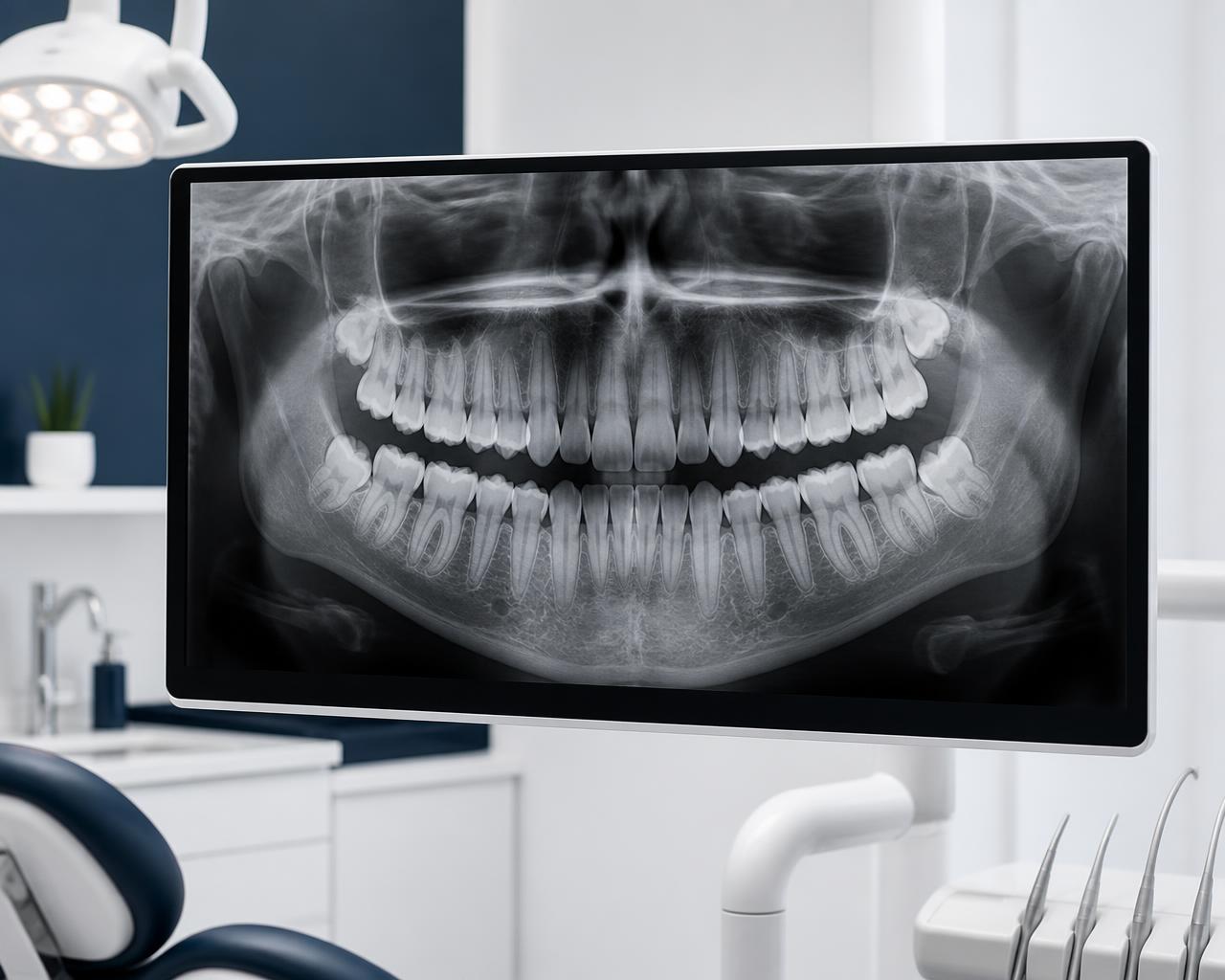
A visual exam can only see the surfaces facing outward. Radiographs show the parts of the mouth that are otherwise hidden: the contact points between teeth where cavities usually start, the bone level around each root, infection at a root tip, impacted or unerupted teeth, and decay creeping beneath an existing filling. Finding those things early is the difference between a small filling and a root canal.
New patient exam vs. recall exam
A new patient exam is longer and more thorough: full history, a complete set of baseline images, charting of every tooth and restoration, and a discussion of what you want from your dental care. A recall exam builds on that baseline and looks for what has changed since the last visit, which is why it is quicker.
At a glance
Dental Exams & X-Rays
- Visit length
- About 30–60 minutes, longer for new patients
- Recommended frequency
- Typically every 6 months — confirm with the office
- X-ray frequency
- Varies by risk — interval confirmed at your exam
- New vs. recall exam
- New patient exams are longer and more detailed
- Anesthesia
- None needed
- Insurance
- Usually the best-covered visit on your plan
or call (202) 363-2810
Imaging
Types of X-Rays We Use
Different images answer different questions. Which ones you need depends on your history and what we are looking for — the exact set is confirmed at your appointment.
Bitewing X-Rays
Taken by biting down on a small sensor, bitewings show the crowns of the upper and lower back teeth together. They are the standard way to find decay starting between teeth, where a mirror and light cannot reach, and to check the bone level around those teeth.
Most commonly at recall visits
Periapical X-Rays
A single-tooth view that captures the whole tooth from the biting surface down past the root tip into the surrounding bone. This is what we take when one tooth hurts, has a deep filling, or shows signs of infection at the root.
When a specific tooth needs investigating
Panoramic X-Rays
One wide image of both jaws, all the teeth, the sinuses, and the jaw joints. It gives the overview that individual films cannot — useful for new patients, wisdom teeth, and anything involving the jaw as a whole.
New patient exams and wisdom tooth assessment
3D Cone Beam Imaging (CBCT)
A three-dimensional scan showing bone height, width, and the position of nerves and sinuses. It is a planning tool rather than a routine screening image, and it is what makes precise implant and surgical planning possible in this office.
Implant, surgical, and complex treatment planning
The 3D cone beam scanner is the same technology used to plan dental implant and surgical cases in this office, which is why that planning does not require a referral elsewhere.
Frequency
How Often Do You Need an Exam?
Nearly everyone is a candidate for preventive care — the real question is the interval. Most patients settle at every six months, but risk history moves that number in both directions.
The standard six-month recall
For most patients with healthy gums and no active decay, an exam and cleaning every six months is the interval that works. It is short enough that anything new is caught while it is still small, and long enough that it is realistic to keep up with.
X-rays are not automatically taken at every one of those visits — they follow their own interval based on your risk.
When more frequent visits are recommended
- 1A history of frequent cavities or recent new decay
- 2Gum disease, past periodontal treatment, or bleeding gums
- 3Diabetes, dry mouth, or medications that reduce saliva
- 4Smoking or tobacco use, which raises both gum disease and oral cancer risk
- 5Pregnancy, which commonly changes gum health
- 6Extensive dental work, implants, or orthodontics to monitor
Your interval is a recommendation we make with you at the exam, not a rule applied to everyone. If you are unsure what applies to your situation, ask us at your visit.
The Process
The Exam & X-Ray Process
Four straightforward stages in a single routine appointment — no anesthetic, no recovery, and you leave knowing exactly where you stand.
Check-In & Health History Review
First few minutes
We review your medical history, medications, and anything that has changed since your last visit — plus any specific concern that brought you in. Medical conditions and medications genuinely affect the mouth, so this is not a formality.
X-Rays (If Due)
Only when indicated
If images are due based on your history and risk, digital X-rays are taken with a lead apron and thyroid collar in place. They appear on the screen immediately, so there is no waiting for film to develop.
Comprehensive Exam
The main assessment
Tooth-by-tooth examination for decay, cracks, and failing restorations, gum and bone health measurements, bite and jaw joint assessment, and a visual and tactile oral cancer screening of the soft tissues.
Discussion of Findings & Next Steps
Before you leave
We walk through the images with you on screen and explain what we found in plain language — what needs attention now, what we are simply monitoring, and when you should come back.
Safety
Is Dental X-Ray Radiation Safe?
This is one of the most common questions we get, and it deserves a direct answer. Digital dental X-rays deliver a very low radiation dose — far lower than the film systems many patients remember, and a small fraction of the natural background radiation everyone is exposed to over a year.
The protective measures we use
- Digital sensors instead of film, which require less exposure to produce an image
- Lead apron and thyroid collar protection for patients when images are taken
- Beam collimation and correct positioning so only the target area is imaged
- Equipment maintained and checked to keep output within its intended range
- Extra caution and discussion if you are or may be pregnant
The ALARA principle
ALARA stands for “as low as reasonably achievable.” In practice it means an X-ray is taken when there is a diagnostic reason for it — a symptom, an interval that has genuinely elapsed, or a planning need — and not simply because you happen to be in the chair. If you have recent images from a previous dentist, we would rather review those than duplicate them.
The American Dental Association’s MouthHealthy guide to dental X-rays is a useful independent overview if you want to read more before your appointment.
Weighing the risk against the alternative
The relevant comparison is not X-ray versus nothing — it is X-ray versus not knowing. Decay between teeth, bone loss, and infection at a root tip are invisible on examination alone and painless until they are advanced. Skipping imaging indefinitely tends to mean problems are found later, when treatment is bigger, longer, and more expensive.
If you are pregnant, worried about cumulative exposure, or simply want to understand why a particular image is being recommended, say so. We will explain the reason for that specific X-ray, and if it can reasonably wait, it waits.
Book AppointmentNext Steps
What Happens After Your Exam
If nothing needs treating
Most exams end here. We note anything we want to keep an eye on, make any home-care suggestions that are actually relevant to your mouth, and book your next visit at the interval we have agreed — usually six months. There is no recovery, no restrictions, and you can eat and go back to work straight away.
If we find something
We show you the image on the screen, explain what we are looking at, and set out the options along with what happens if you leave it. Findings are prioritised — what needs doing now, what can be scheduled, and what is simply being monitored. Nothing is decided under pressure in the chair.
Examples of what “next steps” can look like
Not every exam leads to treatment — many end with a cleaning and a return date. When treatment is needed, these are the routes it most often takes, all handled in this office:
- Early decay caught between teeth is usually restored with a dental filling.
- Decay or infection that has reached the nerve may need root canal treatment.
- An unusual soft-tissue finding is followed up through oral cancer screening and referral if warranted.
- Plaque and tartar build-up is addressed with a professional cleaning.
- Findings in a child’s developing mouth are managed with the same exams, sealants, and fluoride, adapted to a younger patient.
Investment
What Does a Dental Exam Cost in Washington, DC?
Preventive care is the most heavily covered category in most dental plans, so this is one visit where many patients pay little or nothing. Three things determine your actual number.
New patient or returning
- A new patient comprehensive exam is longer and includes baseline imaging
- A periodic recall exam for an established patient is shorter and costs less
- Emergency visits for a specific problem are assessed and quoted separately
Which images are needed
- Bitewings alone cost less than a full series or panoramic image
- 3D cone beam imaging is a planning tool, used only when treatment requires it
- Recent images from a previous dentist can often be reviewed instead of repeated
Your insurance coverage
- Many PPO plans cover preventive exams and X-rays at or near 100%
- Plans set frequency limits, which we check before booking your visit
- We verify your benefits in advance and flag anything not covered
We do not publish a flat price. Your benefits are verified before the appointment and any out-of-pocket amount is confirmed in writing first — payment options and financing are set out on our financial information page.
Why Choose
DC Implant & Cosmetic Dentistry
Preventive care and the treatment that follows it, handled by Dr. Kambez Shukoor in one Connecticut Avenue office.
Digital Imaging, Not Film
Digital sensors and 3D cone beam imaging mean lower radiation doses than traditional film, images on screen in seconds, and views we can zoom into and show you during the appointment.
Exam and Treatment Under One Roof
If your exam finds something, Dr. Kambez Shukoor treats it here — fillings, crowns, root canals, and implant work — rather than referring you out and restarting the conversation somewhere else.
Experienced Diagnostic Eye
FAGD, FICOI, and MICOI credentials across restorative and surgical dentistry, which is what informs the call between watching something and treating it.
Comfortable for Nervous Patients
If it has been years, we start with a conversation, not a lecture. Nitrous, oral, and IV sedation options are available for patients whose anxiety is the barrier.
Conservative, ALARA-Guided Imaging
X-rays are taken when your history and risk indicate they are needed, not on a fixed schedule — with lead apron and thyroid collar protection every time.
Insurance Handled For You
Preventive exams are among the most widely covered services in dentistry. We verify your benefits in advance and explain anything not covered on our financial information page.
FAQ
Dental Exam & X-Ray Questions
The questions Washington, DC patients ask most often about routine exams and imaging.
Related
Preventive Care and What Follows It
The services that sit alongside your exam, and the treatments an exam most often leads to.
Cleanings
The professional cleaning that usually pairs with your exam, removing plaque and tartar brushing leaves behind.
CleaningsOral Cancer Screening
The soft-tissue screening built into every comprehensive exam, and what happens if something looks unusual.
Oral Cancer ScreeningDental Fillings
The usual next step when an X-ray catches decay early, while the repair is still small and straightforward.
Dental FillingsRoot Canal Treatment
What decay that reaches the nerve requires — sometimes found on a routine X-ray before it ever causes pain.
Root Canal TreatmentDue for a check-up — or overdue by a few years?
Book a comprehensive exam and we will tell you exactly where things stand, in plain language, with no lecture about the gap.
4444 Connecticut Ave NW #106, Washington, DC 20008