
Oral & Implant Surgery
Bone Grafting for Dental Implants in Washington, DC
If you were reading about dental implants and were told you may need grafting first, this is that step. Bone grafting rebuilds jawbone lost after tooth loss so an implant has a stable foundation — performed in-house by Dr. Kambez Shukoor as part of the same treatment plan, not a referral elsewhere.

Google Rating
4.9 · 303 reviews
Availability
Same-day consults
Payments
Financing available
Definition
What Is Bone Grafting for Dental Implants?
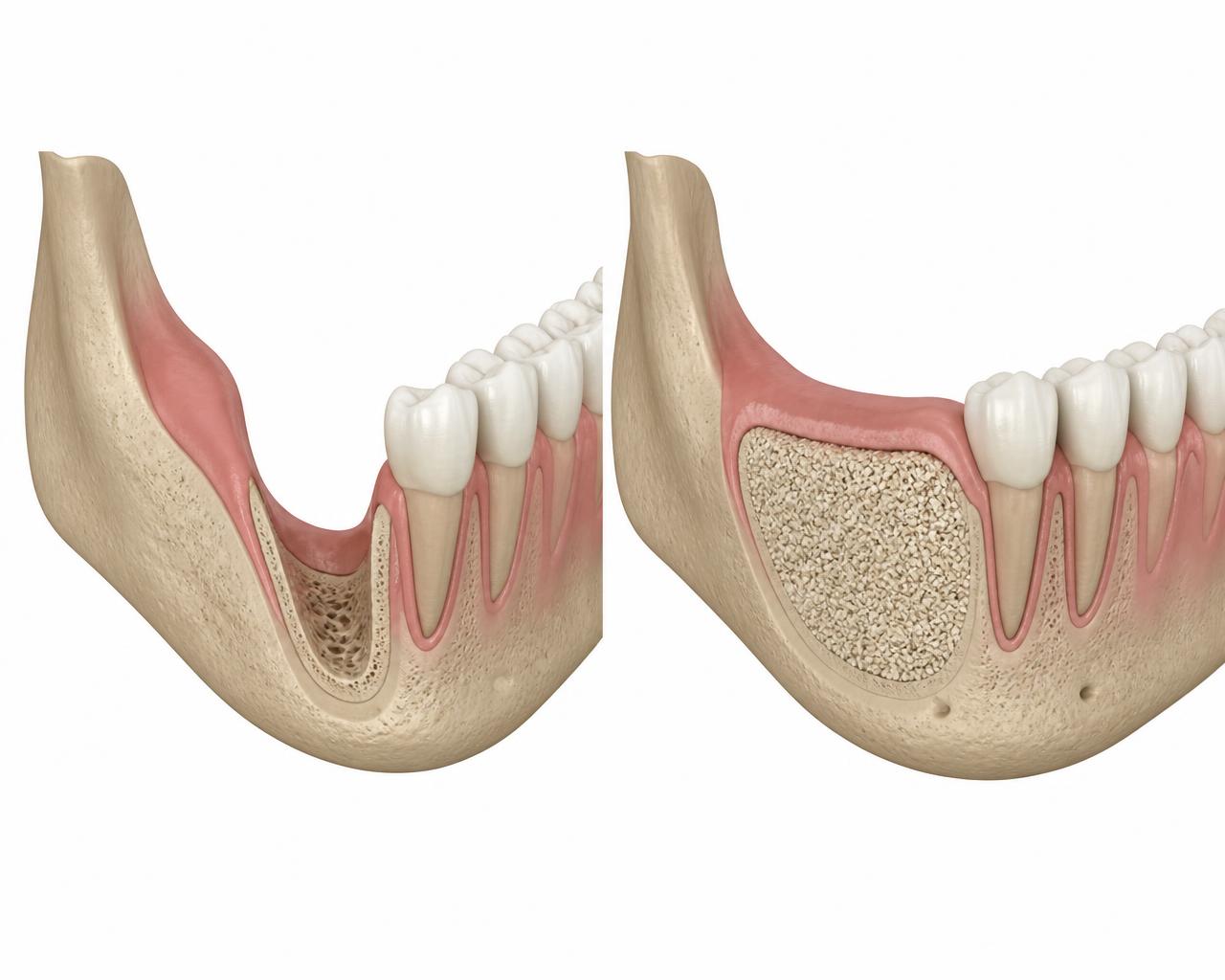
Bone grafting is a procedure that adds bone material to the jaw to rebuild width and height at a site that has lost volume, so a dental implant has enough bone to anchor into. After a tooth is lost, the bone that used to support it begins resorbing — shrinking — within months, and that lost volume does not come back on its own.
That is why grafting comes up so often once implant planning starts. It is not a complication or a setback; it is the preparatory step that makes a single tooth implant or a full mouth reconstruction possible where the ridge has thinned. The graft acts as a scaffold: your own bone grows into it and gradually replaces it, a process closely related to the osseointegration that later locks the implant in place.
Why grafting gets recommended
- A tooth was lost or extracted a year or more ago and the ridge has narrowed
- The 3D scan shows too little bone height or width at the planned implant site
- A socket is being grafted at the time of extraction to preserve it for a future implant
- Long-term denture wear has flattened the ridge beneath the plate
- Periodontal disease or an infection destroyed bone around a failing tooth
At a glance
Bone Grafting for Dental Implants
- Procedure length
- About 45–90 minutes, by site size
- Anesthesia
- Local, with sedation available
- Healing before implant
- Typically 3–6 months
- Same-appointment option
- Possible in some extraction cases
- Performed by
- Dr. Kambez Shukoor
or call (202) 363-2810
Materials
Types of Bone Grafts
Grafts are grouped by where the material comes from. Each behaves differently in healing time and holding power, and the right one depends on how much bone the site is missing.
Allograft
Processed human donor bone from a regulated tissue bank — the material used in most routine implant-site grafts because it avoids a second surgical site.
- No second surgical site — nothing is harvested from you
- Sterilised and screened under tissue-bank regulation
- Acts as a scaffold your own bone grows into and replaces
- Predictable for single-site and ridge-preservation grafts
- Maturation still takes several months before implant placement
Xenograft & Synthetic
Bovine-derived mineral or laboratory-made synthetic granules (alloplast) that hold space in the site while natural bone forms around them.
- Holds ridge volume well and resists early collapse
- No donor-site surgery and unlimited supply
- Often combined with an allograft or a barrier membrane
- Resorbs slowly — some particles stay in place long-term
- Not the first choice for very large defects on its own
Autograft
Your own bone, harvested from another site such as the back of the lower jaw — the biological benchmark, reserved for larger or more demanding defects.
- Your own living cells, so integration is fastest
- Best option for large or vertical bone defects
- No donor material questions at all
- Requires a second surgical site and more recovery
- Limited by how much bone can be harvested
Most implant-site grafts in our office use allograft or xenograft material, often with a barrier membrane; autografts are reserved for larger defects. Which material your case calls for is decided after the 3D scan — and if the upper back jaw is involved, a sinus lift or ridge augmentation may be the more precise description of the procedure you need.
The Process
The Bone Grafting Process
Grafting is one stage inside a longer implant plan. The surgery itself is short; the months that follow are what make the site strong enough to place into.
Consultation & 3D Imaging
Visit 1
A cone-beam scan measures exactly how much bone height and width remain at the site, and where the nerve and sinus sit, so we know whether a graft is genuinely needed and how much material it takes.
Graft Placement
Surgery day
Under local anesthetic, the site is opened, cleaned, and the graft material is packed into the defect — usually protected by a barrier membrane so soft tissue cannot grow into the space.
Initial Healing
Weeks 1–2
The gum closes over the graft. Swelling and soreness fade over the first week or two, and a short review visit confirms the site is sealed and settling as expected.
Bone Integration
3–6 months
This is the long step. The graft matures into your own load-bearing bone. Nothing is rushed here — placing an implant into an immature graft is the fastest way to lose both.
Implant Placement
Once integrated
A follow-up scan confirms the rebuilt volume, then the implant is placed into the grafted site and the original implant plan picks up exactly where it left off.
Candidacy
Do You Need One
Not every implant patient needs a graft. The scan settles it — but these are the patterns that usually point one way or the other.
Signs a graft is likely needed
- 1The tooth has been missing a year or more and the area looks sunken
- 2A visible dip or notch where the ridge has collapsed inward
- 3Imaging shows insufficient bone height or width at the implant site
- 4Bone was destroyed by periodontal disease, infection, or trauma
- 5Years of denture wear have flattened the ridge
When a graft may not be necessary
A recent extraction where the socket walls are intact often holds enough bone to place an implant directly, or needs only a small socket-preservation graft at the same visit. Sites with good existing height and width need nothing added at all, and angled implant positions can sometimes reach solid bone without grafting.
Where the upper back jaw or a broader collapsed span is involved, the procedure is usually named more specifically. These two are the closest neighbors to a standard graft.
Both are performed in-house by Dr. Kambez Shukoor.
Recovery
Recovery After Bone Grafting
Two recoveries, not one
The surface recovery is short: swelling and soreness settle over the first week or two, and you are back to normal routine quickly. The real recovery is the one you cannot feel — three to six months of bone integration before an implant can be placed. Feeling fine at two weeks does not mean the site is ready.
The first 72 hours
- Ice in 20-minute intervals on the first day; swelling peaks around day two
- Soft foods only, and chew away from the graft site
- No smoking and no straws — suction and nicotine both threaten a graft
- Do not rinse forcefully or spit; graft particles can be dislodged
- Take prescribed medication on schedule rather than waiting for pain
Weeks one to six
- Gentle warm salt-water rinses from the day after surgery
- Brush the rest of the mouth normally and keep the site clean as directed
- A short review visit checks that the gum has closed over the graft
- Return to a normal diet gradually, still protecting the site
The integration months
- The graft matures into load-bearing bone over three to six months
- Larger defects and vertical grafts take the longer end of that range
- A follow-up scan confirms the rebuilt volume before implant surgery is booked
- Keeping routine cleanings during this period protects the surrounding tissue
Anxious patients can have grafting done with sedation available alongside local anesthetic.
| Timeframe | What to expect |
|---|---|
| Day 1–3 | Swelling and soreness peak; ice, soft foods, prescribed medication |
| Week 1 | Discomfort fades; most people are back to routine activity |
| Week 2 | Soft tissue closed over the graft; review visit confirms healing |
| Weeks 3–6 | Normal diet resumes gradually — but the graft is still immature |
| Months 3–6 | Bone integration continues; this is the real wait before implants |
| Implant placement | Follow-up scan confirms volume, then the implant is placed |
Investment
What Does Bone Grafting Cost in Washington, DC?
We do not publish a single price, because a small socket graft and a large ridge rebuild are not the same procedure. Here is what moves the number.
Graft material
- Allograft and synthetic materials sit at the lower end
- Autografts cost more because a second surgical site is involved
- Barrier membranes are quoted as their own line item
How much bone is needed
- A single socket takes far less material than a collapsed ridge
- Vertical height is harder to rebuild than width
- Multiple sites are quoted per site, not as one flat fee
Combined or separate visit
- Grafting at the time of extraction or implant placement shares one surgical visit
- A standalone graft carries its own surgical and anesthesia fee
- Sequencing is planned to keep total visits down where it's safe to do so
Grafting is quoted as part of the whole implant plan, not as an isolated surprise — surgery, material, and the implant work that follows are itemized in writing before anything begins. We verify your insurance benefits and explain monthly payment options on our financial information page, including CareCredit and Cherry financing.
Why Choose
DC Implant & Cosmetic Dentistry
Dr. Kambez Shukoor is a U.S. Navy veteran dentist with fellowship-level implant training who handles the surgery and the final prosthesis himself.
Surgery & Crown in One Office
Dr. Shukoor places the implant and restores it himself, so there's no hand-off between a surgeon and a separate restorative dentist.
Implant-Focused Credentials
FAGD, FICOI, and MICOI credentials backed by continuing education specific to implant surgery and prosthetics.
Guided 3D Planning
Cone-beam imaging and digital scanning position every implant before the day of surgery, not during.
Comfort-First Care
Local anesthetic, sedation options, and a slow, explained pace for patients who are anxious about oral surgery.
Honest Case Planning
If a graft isn't necessary — or a different implant approach avoids one — that's what gets recommended.
Transparent Costs
Written treatment plans with itemized fees, insurance coordination, and third-party financing through CareCredit and Cherry.
FAQ
Bone Grafting Questions
The questions Washington, DC patients ask most often before a bone graft for dental implants.
Related
Where This Leads
Grafting is a step on the way to an implant. These are the procedures it prepares you for — and the two related bone-building options.