
Preventive Care
What Are All Those X-Rays For?
Dental X-rays let your dentist see decay, bone loss, and other problems long before they'd be visible to the naked eye. Here's what each type shows and how safe they are.
If you've had a dental exam, you've almost certainly had X-rays taken — but the reasoning behind them isn't always explained. Dental X-rays let your dentist see what's happening beneath the enamel and below the gumline: early decay between teeth, bone loss from gum disease, impacted wisdom teeth, and more, all long before any of it would be visible or cause pain.
Different X-ray types serve different purposes, and none of them are taken just as routine paperwork. Each image answers a specific clinical question your dentist needs answered to catch problems early, when they are simplest and least expensive to treat.
Here is a closer look at the main types of dental X-rays, why each is used, and what to know about safety.
Why X-Rays Matter for Early Detection
A visual exam alone can't catch everything. Decay often starts between teeth or beneath the gumline, in spots a dentist simply cannot see directly no matter how good the lighting or the mirror. The same is true for bone loss around the roots, cysts, and problems with unerupted teeth. X-rays fill that gap, and the earlier a problem is caught, the smaller and less invasive the treatment tends to be — a small cavity caught on a bitewing is a simple filling; the same spot left unchecked for years can progress to needing a root canal.
Panoramic X-Rays
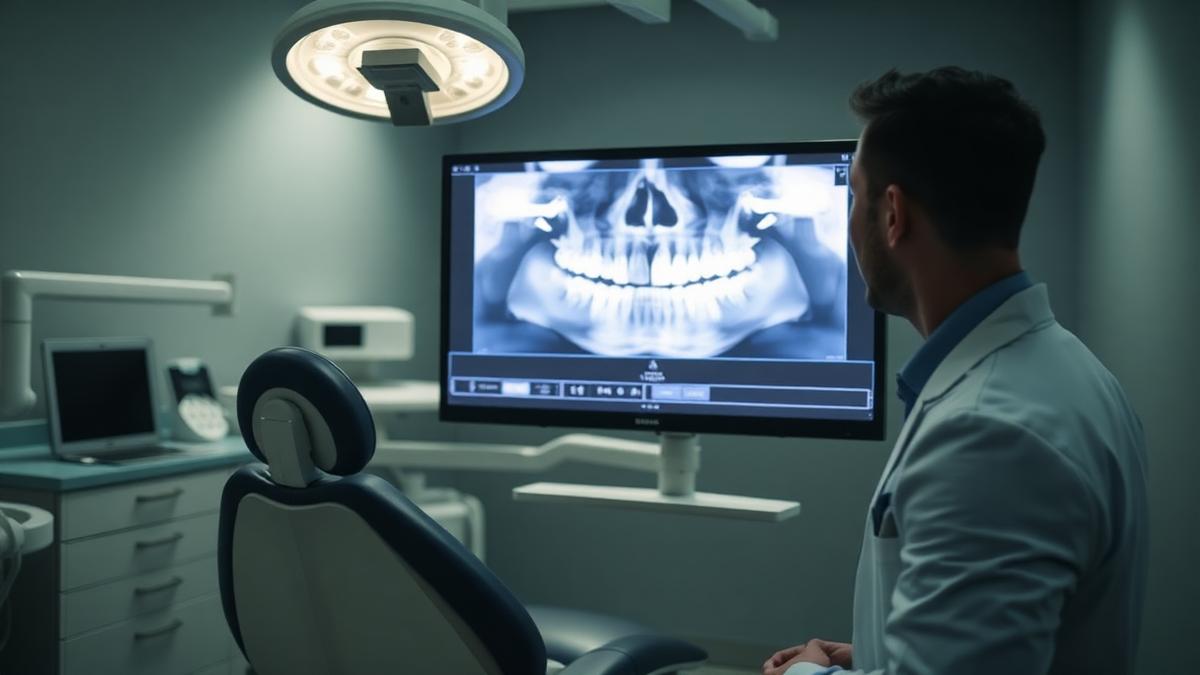
A panoramic X-ray captures the entire upper and lower dental arch in a single wide image, rotating around your head to produce one continuous picture. It shows erupted teeth, incoming adult teeth, and wisdom teeth that haven't come in yet, which helps your dentist judge whether there is enough room for them or whether extraction will eventually be needed. Panoramic images are also useful for spotting cysts, tumors, and abscesses that develop below the gumline in the jawbone, and for evaluating jaw joint structure.
Bitewing X-Rays
Bitewing X-rays are the familiar ones where you bite down on a small piece of plastic or film to hold it in place. Typically four are taken — one per quadrant of the mouth — giving a closer look at the crowns of the upper and lower back teeth and the contact points between them. Bitewings are especially good at revealing cavities forming between teeth and early bone loss at the gumline, both of which are difficult to detect with a visual exam alone.
Periapical X-Rays
A periapical X-ray zooms in on a single tooth, capturing the entire tooth from crown to root tip along with the surrounding bone. These are typically taken when there is already a specific concern — persistent pain, a suspected infection, or an abnormality at the root — and they can be taken alongside bitewings for a fuller picture of the same area.
How Often X-Rays Are Needed
The right frequency depends on your individual risk factors, not a single fixed rule. Patients with a history of cavities, active gum disease, or ongoing dental treatment may need bitewings more often — sometimes every six to twelve months — while patients with consistently healthy checkups may go longer between images. Panoramic X-rays are typically taken less frequently, often every few years or when monitoring wisdom teeth or orthodontic development. Your dentist will recommend a schedule based on your history and current oral health rather than defaulting to X-rays at every visit.
X-Ray Radiation and Patient Safety
It's a reasonable question to ask how much radiation exposure is involved. Dental X-rays use very low radiation doses, and modern digital sensors have reduced that exposure further compared to older film-based systems. We also provide a lead apron and, when appropriate, a thyroid collar to minimize exposure to the rest of the body. Dental X-rays are considered safe for the large majority of patients, including with the protective measures used routinely in our office.
If you are pregnant or think you might be, or if you have any specific health concerns, let us know before any imaging is taken so we can adjust as needed.
What to Expect at Your Visit
If it's been a while since your last dental exam, your visit will likely start with an updated set of X-rays so your dentist has a current baseline to work from, followed by a visual exam and a professional cleaning. From there, your dentist can walk you through exactly what the images show and answer any questions about what, if anything, needs attention.
Due for a checkup? Schedule your next exam with our Washington, DC team, and we'll make sure everything looks good — both inside and out.
Questions
Frequently asked questions
Talk it through with our team
Have a question this article did not answer? Our Washington, DC team is happy to help — call (202) 363-2810 or book online.
4444 Connecticut Ave NW #106, Washington, DC 20008